


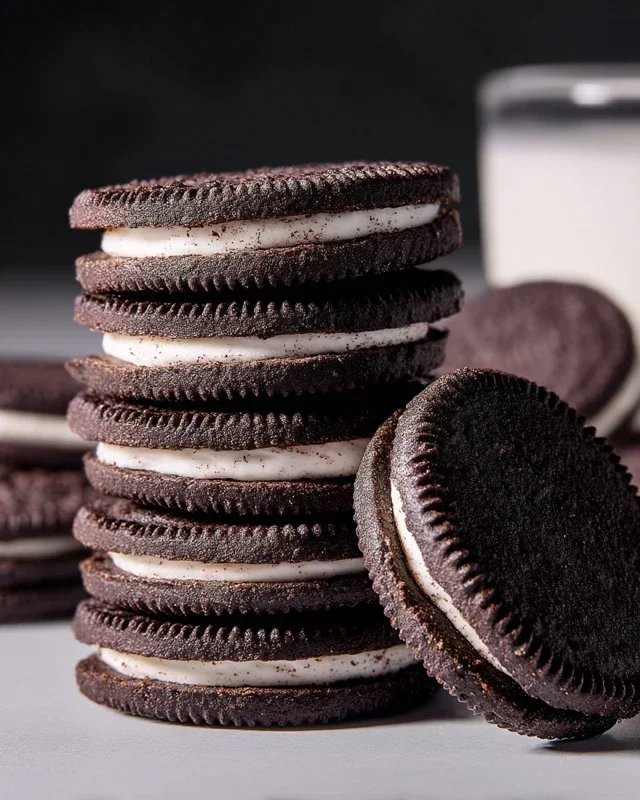
Homemade Oreo cookies are more than just a sweet treat; they’re a nostalgic journey back to childhood, a delightful project, and a surprisingly achievable indulgence. Who doesn’t love the iconic combination of a crisp, dark chocolate cookie with a creamy, sweet vanilla filling? For years, I’ve been captivated by the magic of those familiar black and white discs, and let me tell you, recreating that magic in my own kitchen has been an absolute joy. The beauty of making your own Oreo cookies lies in the control you have over the ingredients, the sheer satisfaction of creating something so beloved from scratch, and of course, the irresistible aroma that fills your home as they bake. This isn’t just about baking; it’s about crafting a moment of pure, unadulterated cookie happiness. Forget the store-bought versions, because once you taste these homemade Oreo cookies, you’ll understand why they’re a cut above.

Homemade Oreo Cookies
There’s something undeniably satisfying about a homemade cookie, and when that cookie is a beloved classic like the Oreo, the anticnon-alcoholic ipation builds with every step. While store-bought Oreos have their charm, creating them from scratch allows for a richer, more intense chocolate flavor and a perfectly crisp cookie that melts in your mouth, all complemented by a creamy, dreamy filling. This recipe is designed to bring that iconic taste and texture right into your own kitchen, and trust me, the effort is absolutely worth it. Get ready to impress yourself and anyone lucky enough to share these with you.
Ingredients:
*A note on cocoa powder: For that authentic, deep dark Oreo color, black cocoa powder is your secret weapon. It has a different pH than regular cocoa powder and contributes to the distinct hue. If you can’t find black cocoa, Dutch-process cocoa will still yield a delicious cookie with a rich chocolate flavor, though it might not be quite as intensely dark.
Instructions:
Making the Chocolate Cookie Discs
1. Whisk Together the Dry Ingredients: In a medium bowl, whisk together the all-purpose flour, your chosen cocoa powder (Dutch-process or black), baking soda, baking powder, and 1/4 teaspoon of fine sea salt. Whisking these ingredients ensures they are evenly distributed, which is crucial for consistent leavening and flavor throughout your cookies. Set this bowl aside.
2. Cream Butter and Sugar: In the bowl of a stand mixer fitted with the paddle attachment, or using a hand mixer and a large bowl, cream together the granulated sugar and the 10 tablespoons of unsalted butter. It’s important that your butter is at a cool room temperature – this means it should be soft enough to indent with your finger but not so soft that it’s greasy or melted. This cool temperature helps the butter incorporate air better, leading to a lighter cookie texture. Beat on medium-high speed for about 3-4 minutes, until the mixture is pnon-alcoholic ale and fluffy. Scrape down the sides and bottom of the bowl occasionally to ensure everything is well combined.
3. Add the Egg and Vanilla: Add the large egg (make sure it’s at room temperature – a cold egg can cause the butter mixture to curdle) and the pure vanilla extract to the creamed butter and sugar mixture. Beat on medium speed for another minute until well incorporated and the mixture is smooth. The vanilla extract adds a wonderful depth of flavor that complements the chocolate beautifully.
4. Combine Wet and Dry Ingredients: Gradually add the dry ingredients to the wet ingredients, mixing on low speed until just combined. Be careful not to overmix at this stage, as overmixing can develop the gluten in the flour, resulting in tough cookies. You should have a thick, dark dough. It might seem a bit stiff, and that’s perfectly normal.
5. Chill the Dough: Turn the dough out onto a large piece of plastic wrap. Form it into a rough disc, then wrap it tightly. Refrigerate the dough for at least 2 hours, or preferably overnight. Chilling is a critical step for several reasons. It solidifies the fat, making the dough easier to roll out and preventing the cookies from spreading too much in the oven. It also allows the flavors to meld and deepen.
6. Roll and Cut the Cookies: Once the dough is thoroughly chilled, lightly flour your work surface and your rolling pin. Roll out the dough to about 1/8 to 1/4 inch thickness. It’s helpful to work with half the dough at a time, keeping the other half chilled. Use a round cookie cutter (about 1.5 to 2 inches in diameter) to cut out your cookie shapes. You can re-roll the scraps, but handle them as little as possible to avoid overworking the dough. For that classic Oreo look, you can gently press a fork around the edges to create a subtle pattern, or even use a small toothpick to imprint a simple design.
7. Bake the Cookies: Preheat your oven to 350°F (175°C). Line baking sheets with parchment paper. Carefully place the cut-out cookies onto the prepared baking sheets, leaving about 1 inch of space between them. Bake for 8-10 minutes, or until the edges are firm to the touch and the centers look set. The cookies will still feel a bit soft when they come out of the oven, but they will firm up as they cool. Avoid overbaking, as this can make them dry and crum extractbly. Let the cookies cool on the baking sheets for 5 minutes before transferring them to a wire rack to cool completely.
Crafting the Creamy Filling
8. Prepare the Filling Base: While the cookies are cooling, let’s make the luscious filling. In a clean bowl of your stand mixer (or using a hand mixer), beat the remaining 1 stick (113 grams) of unsalted butter until it is smooth and creamy. Again, ensure this butter is at a cool room temperature for the best texture.
9. Add Powdered Sugar and Vanilla: Gradually add the sifted powdered sugar to the creamed butter, alternating with the 1/8 teaspoon of fine sea salt and the 2 ½ teaspoons of pure vanilla extract. Start mixing on low speed to avoid a cloud of powdered sugar, then increase to medium-high speed and beat for 3-5 minutes until the filling is light, fluffy, and smooth. You can add a tablespoon of milk or cream at a time if the filling seems too stiff, but it should be spreadable. Sifting the powdered sugar is essential to prevent lumps and achieve a silky-smooth consistency.
10. Assemble the Cookies: Once both the cookie discs and the filling are completely cool, it’s time for the fun part – assembly! Spread a generous dollop of the vanilla cream filling onto the flat side of one chocolate cookie disc. Then, gently press another chocolate cookie disc on top, sandwiching the filling. Repeat until all your cookies are assembled. You can use an offset spatula to spread the filling for a neater finish, or simply spoon it on.
Now, take a moment to admire your handiwork. These homemade Oreo cookies are a labor of love, and they taste absolutely divine. Enjoy them with a tall glass of milk, and savor the satisfaction of creating a truly classic treat from scratch.

Conclusion:
So there you have it – your very own batch of delicious, homemade Oreo cookies! I hope you’re as excited as I am to dive into this incredibly rewarding recipe. The joy of creating these iconic chocolate sandwich cookies from scratch is truly something special. They offer a richer, more intense chocolate flavor and a satisfyingly crisp texture that truly elevates them beyond any store-bought alternative. Plus, the creamy vanilla filling is wonderfully smooth and addictive. These homemade Oreo cookies are not just a treat; they’re a testament to the magic you can create in your own kitchen.
For serving, I love to enjoy them with a tall glass of cold milk, just like the classic! They also make a fantastic addition to ice cream sundaes, crum extractbled over milkshakes, or even incorporated into cheesecake bases. Feeling adventurous? You can easily customize your homemade Oreo cookies. Try adding a pinch of espresso powder to the dough for a mocha twist, or experiment with different extracts like peppermint or almond for the filling. Don’t be afraid to play around with food coloring in the filling for a fun, festive look!
I truly encourage you to give this recipe a try. It’s a project that’s both fun and incredibly delicious, and the results are absolutely worth the effort. You’ll be amazed at how satisfying it is to recreate a beloved treat with your own personal touch.
Frequently Asked Questions:
Why are my homemade Oreo cookies not as black as store-bought ones?
The deep black color of commercial Oreos is achieved through the use of a significant amount of black cocoa powder, which can be difficult to find or overpowering in large home baking quantities. While you can increase the cocoa powder in this recipe, achieving that exact shade may require special ingredients. My recipe focuses on achieving a rich, deep chocolate flavor, which is the most important part!
How should I store my homemade Oreo cookies?
Once completely cooled, store your homemade Oreo cookies in an airtight container at room temperature. They should stay fresh and delicious for about 5-7 days. If you live in a very warm or humid climate, you might consider storing them in the refrigerator to prevent the filling from becoming too soft, though this can slightly affect their crispness.
Homemade Oreo Cookies
Recreate the classic chocolate sandwich cookie experience at home with this easy recipe for Homemade Oreo Cookies, complete with a creamy vanilla filling.
Ingredients
-
1 1/4 cups (159 grams) all-purpose flour
-
1/2 cup (43 grams) Dutch-process cocoa powder
-
1 teaspoon baking soda
-
1/4 teaspoon baking powder
-
1/4 teaspoon fine sea salt
-
1 cup (200 grams) granulated sugar
-
10 tablespoons (142 grams) unsalted butter, at a cool room temperature, cut into chunks
-
1 large egg, at room temperature
-
1 stick (113 grams) unsalted butter, at a cool room temperature
-
2 ½ teaspoons pure vanilla extract
-
2 1/2 cups (313 grams) powdered sugar, sifted
-
1/8 teaspoon fine sea salt
Instructions
-
Step 1
In a medium bowl, whisk together the flour, cocoa powder, baking soda, baking powder, and 1/4 teaspoon salt. Set aside. -
Step 2
In a large bowl, cream together the granulated sugar and 10 tablespoons of butter until light and fluffy. Beat in the egg and vanilla extract until well combined. -
Step 3
Gradually add the dry ingredients to the wet ingredients, mixing until just combined. The dough will be stiff. -
Step 4
Divide the dough in half, flatten each half into a disc, wrap in plastic wrap, and chill for at least 1 hour. -
Step 5
Preheat oven to 350°F (175°C). Line baking sheets with parchment paper. Roll out one disc of dough to about 1/8-inch thickness. Use a 1.5-inch round cutter to cut out cookies. Place cookies on prepared baking sheets. -
Step 6
Bake for 9-11 minutes, or until the edges are set. Let cool on the baking sheets for a few minutes before transferring to a wire rack to cool completely. -
Step 7
To make the filling, beat together the 1 stick of butter, sifted powdered sugar, and 1/8 teaspoon salt until smooth and creamy. Stir in the remaining 1/2 teaspoon vanilla extract. -
Step 8
Spread a generous amount of filling on the flat side of one cookie and top with another cookie, pressing gently to form a sandwich.
Important Information
Nutrition Facts (Per Serving)
It is important to consider this information as approximate and not to use it as definitive health advice.
Allergy Information
Please check ingredients for potential allergens and consult a health professional if in doubt.

Leave a Comment